
Programmable CBDCs: An Economic Tool for Welfare Policies
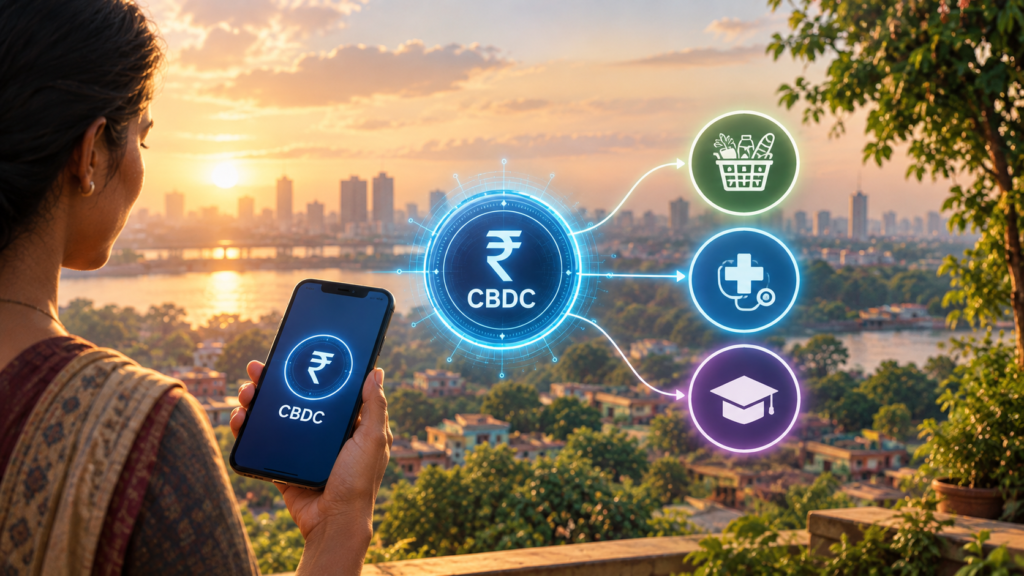
CBDCs could become more than a new form of digital money—they could become a new mechanism for implementing public policy. Programmable CBDCs could enable governments to direct welfare payments towards specific objectives, from food and healthcare to education, while reducing intermediary leakages and creating greater visibility over how public funds are used. But the same programmability that strengthens policy targeting also gives the state greater capacity to influence individual spending decisions. Drawing on welfare economics and behavioural economics, this article examines the potential of programmable CBDCs to improve social protection while asking a fundamental question: when does conditional welfare become paternalism, and how much individual autonomy should governments trade for greater policy effectiveness?
Central Bank Digital Currencies (CBDCs) have begun to shape the course of monetary experiments around the world. With the exacerbating digital and online transactions across the globe coupled with the rapidly changing financial global order, the central banks are pondering beyond the current approach. Around 137 countries and currency unions are introspecting sovereign digital currency possibilities, with 72 in the advanced phase of exploration. Out of the 33 CBDC programs tracked by CBDC Registry, the global database, 64% have programmable capability coverage. With advanced traits for the currency architecture, they are no longer theoretical rather are the instruments for state policy designs.
The programmable feature within the digital currency elevates the purpose with its built-in rules to control how, when and by whom it can be used. Pre-defined conditions enable self-execution of the currency, unlike the traditional money that has a third party like a bank or intermediaries. It is this conditionality aspect of the digital asset that addresses a critical policy problem that exists in almost all countries.
Historically, governments have been facing leakages, administrative inefficiencies and intermediary interferences in social protection and welfare programs. Take India for example, welfare benefits were routed through multiple layers – creating opportunities for delays, corruption and exclusion. However, the JAM trinity – Jan Dhan Yojana, Aadhaar and Mobile architecture has built an ecosystem to transfer the benefits directly into the beneficiaries bank account, eliminating intermediaries, removing duplicates and saving cost for the government. Similarly, Brazil’s Bolsa Familia programme, one of the world’s largest conditional cash transfer initiatives links the scheme to health and educational milestones of the children. The intent of the government is to ensure that the cash transferred to the beneficiaries is being utilised for the specific purpose only. It tries to strengthen the outputs, health and education outcomes, targeted by the government.
However, cash transfer programs in this format may face challenges due to the leakages within the process of transfer or when the beneficiary itself might not use the financial assistance for the intended purpose. With an unrestricted transfer of cash by the government for the beneficiary, it can even be spent on any goods or service that do not contribute to the stated policy objective, including alcohol or other non-essential consumption. Further, money is fungible. If someone receives Rs 100 of food-restricted CBDC, they might spend it on groceries and then use Rs 100 of their existing income for alcohol. So programmability doesn’t necessarily eliminate undesirable consumption; it changes which resources are constrained.
The whole point of discussion is how can we integrate the potential features of CBDC into the welfare policies of the government to improve a set of basic improvements in the life of the public – be it health, education or any other sector. There is strong possibility for CBDC-backed policy strategies that can strengthen outcome targeting, reduce leakages, eliminate middlemen, create real-time transaction databases that improves evaluation and accountability and enhances overall transparency of the welfarist measures.
Apart from these possibilities that need to be considered, there lies an important contention. Is a restricted and conditional transfer of money to the beneficiaries a form of paternalism, whereby the policymakers design welfare policies by limiting their individual choice and autonomy? However, individuals do not always make decisions that maximise their long-term welfare or impacts in life, particularly where present bias, temptation or self-control problems influence consumption choices.
Hence, the policy question is therefore not simply whether governments can programme welfare payments, but whether the efficiency gains justify the accompanying restrictions on individual choice. With parallel financial instruments taking spots in the economy, the governments and multilateral agencies can explore CBDCs’ capacity beyond their active utilities.